
Why do planes almost never crash but people are still terrified of flying?

Every day, millions of passengers grip their armrests during takeoff, convinced they're about to die—despite boarding the safest form of long-distance travel ever invented. This striking paradox reveals a fascinating collision between cold statistics and hot emotions, where our Stone Age brains struggle to process Space Age safety. Understanding why rational humans remain terrified of flying requires examining both the remarkable engineering that makes modern aviation extraordinarily safe and the psychological quirks that make our fears so stubbornly persistent.
The Statistical Reality of Aviation Safety
The numbers surrounding aviation safety are genuinely staggering. According to the National Safety Council, the lifetime odds of dying in a motor vehicle accident are approximately 1 in 107, while the odds of dying in a plane crash are roughly 1 in 11,085[1]. The International Air Transport Association (IATA) reported that in 2022, there was one accident for every 1.2 million flights, with a fatal accident rate of just 0.16 per million flights[2].
To put this in perspective: based on current accident rates, you would need to fly daily for thousands of years before experiencing a statistically average fatal crash[3]. Commercial aviation has become so safe that flying is statistically much safer per mile than driving, with ratios varying from 10 to 50 times safer depending on methodology. The Aviation Safety Network's data shows this safety record represents continuous improvement, with specific accident categorization varying between sources depending on whether they include cargo flights, charter operations, or only passenger services[4].
This safety record represents dramatic improvement over time. In the 1970s, fatal accident rates were approximately 20 times higher than today's levels. The implementation of advanced safety management systems, improved pilot training protocols, enhanced aircraft design, and sophisticated air traffic control has created multiple layers of protection that make catastrophic failures extraordinarily rare.
Engineering Marvels Behind Aviation Safety
Modern aircraft incorporate numerous redundant safety systems designed with "fail-safe" principles. Commercial jets typically have multiple backup systems for critical functions—if one hydraulic system fails, two others can maintain control. Engines are designed to operate independently, allowing aircraft to fly safely on a single engine if necessary[5].
The certification process for commercial aircraft is exhaustive. Before entering service, new aircraft designs undergo years of testing, including extreme weather conditions, structural stress tests, and failure scenario simulations. The Federal Aviation Administration (FAA) requires that aircraft demonstrate the ability to survive catastrophic engine failures, severe turbulence, and various emergency scenarios[6].
Pilot training has also evolved dramatically. Modern commercial pilots undergo rigorous initial training followed by recurrent training every six months. They practice emergency procedures in sophisticated flight simulators that can replicate virtually any conceivable failure scenario. The implementation of Crew Resource Management (CRM) training has significantly reduced accidents caused by human error by improving communication and decision-making in the cockpit[7].
The Psychology of Fear and Risk Perception
Despite these objective safety improvements, human psychology works against rational risk assessment when it comes to flying. Several cognitive biases contribute to the persistence of flight anxiety, even among people who intellectually understand aviation safety statistics.
The availability heuristic plays a crucial role in flight anxiety. This psychological principle suggests that people judge the probability of events based on how easily they can recall examples[8]. Plane crashes receive extensive media coverage, creating vivid, memorable images that make such events seem more common than they actually are. Meanwhile, the millions of safe flights that occur daily receive no media attention, creating a distorted perception of risk.
Control is another fundamental factor. When driving, individuals feel they can influence outcomes through their actions—braking, steering, or avoiding dangerous situations. In an aircraft, passengers must completely surrender control to pilots and systems they cannot see or understand[9].
The concept of "dread risk" also applies strongly to aviation. Research by psychologist Paul Slovic identified that people fear risks that are catastrophic, involuntary, and unfamiliar more than risks that are voluntary, familiar, and chronic[10]. Plane crashes typically involve multiple fatalities simultaneously, occur without individual choice in the moment, and involve complex technology that most passengers don't understand—hitting all the markers for maximum psychological dread.
Media Coverage and the Amplification of Fear
Media coverage patterns significantly distort public perception of aviation risk. When plane crashes occur, they dominate news cycles for days or weeks, featuring dramatic footage, survivor interviews, and detailed investigations. This intensive coverage creates what researchers call the "media amplification effect," where repeated exposure to rare events makes them seem more probable[11].
Research by Combs and Slovic found that media coverage of plane crashes was disproportionate to their actual frequency compared to other transportation accidents. Car accidents, which kill approximately 42,795 Americans annually according to 2022 NHTSA data, receive minimal individual coverage unless they involve celebrities or unusual circumstances. Meanwhile, plane crashes, which kill fewer than 500 Americans in most years, generate extensive coverage that can last weeks[12].
Social media has amplified this effect further. Passengers now share real-time experiences of turbulence, mechanical issues, or emergency landings, creating a constant stream of aviation-related anxiety content. While these events typically end safely, the emotional impact of seeing someone's fear in real-time can be more powerful than abstract safety statistics.
Evolutionary and Physiological Factors
Human fear responses evolved over millions of years to help our ancestors survive ground-based threats. We developed sophisticated systems for assessing risks like predators, heights, enclosed spaces, and loss of control—all elements present in air travel. Flying triggers multiple evolutionary fear responses simultaneously: fear of heights (acrophobia), fear of enclosed spaces (claustrophobia), and fear of falling[13].
The physical sensations of flight—acceleration during takeoff, pressure changes, turbulence, and the feeling of being suspended in air—can trigger fight-or-flight responses even when no actual danger exists. The inner ear, which helps maintain balance and spatial orientation, can become confused during flight, leading to disorientation and anxiety. These physiological responses occur regardless of intellectual knowledge about safety statistics.
Additionally, humans are naturally poor at assessing very low-probability, high-consequence events. Our brains evolved to handle immediate, visible threats rather than statistical abstractions. The concept of "one in a million" risk is difficult to process emotionally, even when understood intellectually.
Cultural and Social Influences
Cultural factors also shape aviation anxiety. In societies where flying is less common, fear levels tend to be higher due to unfamiliarity. Family attitudes toward flying, often passed down through generations, can significantly influence individual comfort levels. Social learning theory suggests that children who observe parental anxiety about flying are more likely to develop similar fears[14].
Hollywood and popular culture have contributed to aviation fears through dramatic portrayals of plane crashes in movies and television shows. Films like "Final Destination," "Alive," and "Cast Away" create vivid, emotionally charged scenarios that can influence subconscious associations with flying, even when viewers consciously recognize these as fictional entertainment.
The post-9/11 security environment has also influenced flying anxiety. While enhanced security measures have made aviation safer from terrorism, the visible security apparatus—body scanners, extensive screening procedures, and armed security personnel—can create an atmosphere that suggests flying is inherently dangerous, even though these measures are largely preventive.
Comparing Aviation to Other Transportation Risks
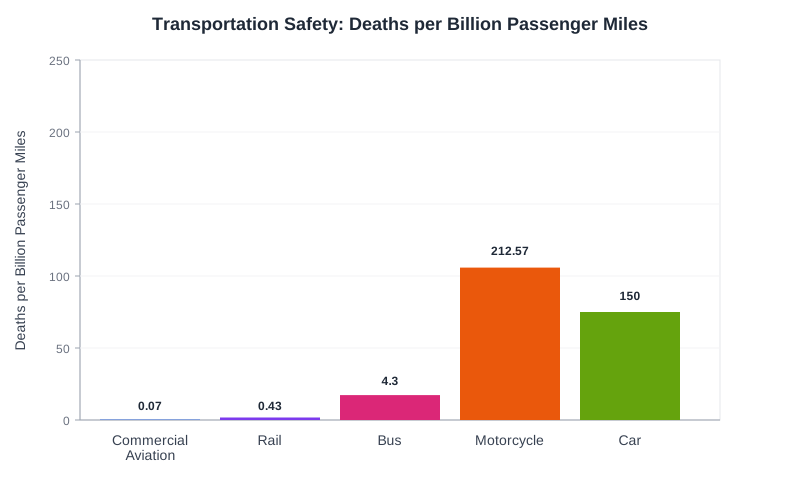
When aviation safety is compared to other forms of transportation, the contrast becomes striking. The National Highway Traffic Safety Administration reports that driving has significantly higher fatality rates per mile traveled than commercial aviation, with studies showing ratios ranging from approximately 10 to 50 times higher depending on methodology[15]. Yet most people feel comfortable driving daily while fearing occasional flights.
Railroad travel, often perceived as safer than flying, actually has higher fatality rates per passenger mile than commercial aviation. Maritime travel, while generally safe, also exceeds aviation fatality rates. Even walking has higher fatality rates per mile than flying when accounting for pedestrian accidents[16].
This comparison highlights how risk perception differs dramatically from statistical reality. The familiarity and perceived control associated with driving, combined with the gradual, distributed nature of automotive fatalities, makes car travel feel safer despite objective evidence to the contrary.
Overcoming Flight Anxiety
Understanding the disconnect between perception and reality has led to various approaches for addressing flight anxiety. Cognitive-behavioral therapy (CBT) has shown significant success in treating aviophobia by helping individuals recognize and challenge irrational thoughts about flying[17]. Many airlines now offer "fear of flying" courses that combine education about aircraft safety systems with exposure therapy.
Exposure to accurate information about aviation safety can help, though emotional fears often persist despite intellectual understanding. Some effective strategies include learning about aircraft systems, understanding turbulence as uncomfortable but not dangerous, and practicing relaxation techniques. Virtual reality exposure therapy is also showing promise as a treatment option for severe flight anxiety.
While aviation statistics show remarkable safety improvements, some experts argue that fear of flying may actually serve an adaptive function—encouraging passengers to research airlines, avoid budget carriers with poor maintenance records, and stay alert to safety briefings. This "rational anxiety" could explain why aviation safety continues improving: public fear maintains pressure on regulators and airlines to prioritize safety investments over cost-cutting measures.
The statistical comparison between flying and driving may be misleading since it compares per-mile fatality rates across vastly different trip lengths and purposes. A more relevant comparison might examine the safety of a typical 500-mile car trip versus a 500-mile flight, or consider that many people only fly a few times per year while driving daily—making the psychological weight of that single flight risk feel more significant than dispersed driving risks.
Key Takeaways
- Commercial aviation is statistically the safest form of long-distance travel, with lifetime odds of a fatal crash at approximately 1 in 11,085
- Multiple redundant safety systems, rigorous testing protocols, and extensive pilot training have created an exceptionally safe transportation system
- Psychological factors including the availability heuristic, loss of control, and evolutionary fear responses make flying feel more dangerous than statistics indicate
- Media coverage amplifies perception of aviation risk by providing extensive coverage of rare crashes while ignoring millions of safe flights
- Human brains evolved to handle immediate, visible threats rather than statistical abstractions, making very low-probability risks difficult to process emotionally
- Cultural influences, social learning, and popular media portrayals contribute to persistent flight anxiety despite objective safety improvements
- Cognitive-behavioral therapy and education about aviation safety systems can help address flight anxiety, though emotional responses often persist despite intellectual understanding
References
- National Safety Council. "Injury Facts: Lifetime Odds of Death." NSC.org, 2023.
- International Air Transport Association. "2022 Airline Safety Performance." IATA Press Release, March 7, 2023.
- Barnett, Arnold. "Aviation Safety: A Whole New World?" Transportation Science, Vol. 54, No. 1, 2020.
- Aviation Safety Network. "Annual Safety Review 2022." Flight Safety Foundation, 2023.
- Federal Aviation Administration. "Transport Category Aircraft Certification." FAA.gov, 2023.
- Stolzer, Alan J., Carl D. Halford, and John J. Goglia. Safety Management Systems in Aviation. Ashgate Publishing, 2011.
- Helmreich, Robert L., and Ashleigh C. Merritt. Culture at Work in Aviation and Medicine. Ashgate Publishing, 1998.
- Tversky, Amos, and Daniel Kahneman. "Availability: A heuristic for judging frequency and probability." Cognitive Psychology, Vol. 5, No. 2, 1973.
- Slovic, Paul. "Perception of risk." Science, Vol. 236, No. 4799, 1987.
- Slovic, Paul, Baruch Fischhoff, and Sarah Lichtenstein. "Rating the risks." Environment: Science and Policy for Sustainable Development, Vol. 21, No. 3, 1979.
- Kasperson, Roger E., et al. "The social amplification of risk: A conceptual framework." Risk Analysis, Vol. 8, No. 2, 1988.
- Combs, Barbara, and Paul Slovic. "Newspaper coverage of causes of death." Journalism Quarterly, Vol. 56, No. 4, 1979.
- Öhman, Arne, and Susan Mineka. "Fears, phobias, and preparedness: toward an evolved module of fear and fear learning." Psychological Review, Vol. 108, No. 3, 2001.
- Bandura, Albert. Social Learning Theory. Prentice Hall, 1977.
- National Highway Traffic Safety Administration. "Traffic Safety Facts Annual Report." NHTSA.gov, 2023.
- Beck, Laurie F., et al. "Transportation-related injuries in the United States." American Journal of Preventive Medicine, Vol. 53, No. 2, 2017.
- Oakes, Megan, and Tim Bor. "The effectiveness of cognitive behavioral therapy for aviophobia." Clinical Psychology Review, Vol. 30, No. 8, 2010.