How Do Natural Disasters and Crises Inspire Musical Expression and Social Change?
When the earth shakes, when waters rise, when communities crumble—music rises from the rubble. Throughout history, natural disasters and crises have served as catalysts for some of the most powerful and enduring musical expressions, transforming personal trauma into collective healing and social action. From the blues born of the Mississippi River floods to the punk anthems emerging from urban decay, catastrophe has consistently sparked artistic innovation that transcends entertainment to become a force for social change.
Natural disasters continue to devastate communities worldwide, serving as stark reminders of nature's power. Yet these tragedies consistently inspire new waves of musical expression—songs that capture not just the immediate horror, but the resilience, solidarity, and transformation that follow. Understanding how disasters shape music reveals fundamental truths about art's role in processing trauma and mobilizing communities for change.
The Historical Blueprint: How Catastrophe Creates Music
The relationship between disaster and musical innovation runs deep through American musical history. The Great Mississippi Flood of 1927, which displaced over 700,000 people, directly inspired a generation of blues musicians[1]. Bessie Smith's "Backwater Blues" and Big Joe Williams' "Mississippi Heavy Water Blues" didn't just document the disaster—they transformed collective suffering into art that spoke to broader experiences of displacement and loss.
Similarly, the Dust Bowl of the 1930s produced Woody Guthrie's "Dust Bowl Blues" and inspired the folk revival that would later fuel the civil rights movement[2]. These weren't merely topical songs; they became anthems that helped communities process trauma while building solidarity for social change. The musical response to the 1906 San Francisco earthquake included ragtime compositions that celebrated the city's resilience, establishing a template for how music can transform disaster narratives from despair to hope.
More recently, Hurricane Katrina in 2005 sparked an unprecedented musical response across genres. New Orleans musicians like Treme Brass Band and Rebirth Brass Band created funeral dirges that evolved into celebrations of survival[3]. Hip-hop artists including Lil Wayne, Master P, and Juvenile released tracks that documented both government failures and community resilience. The disaster also inspired cross-genre collaborations, such as the "Song for New Orleans" project featuring artists from Wynton Marsalis to Allen Toussaint.
Global Patterns: International Responses to Natural Disasters
The phenomenon extends far beyond American borders. Japan's response to the 2011 Tōhoku earthquake and tsunami demonstrates how disaster-inspired music can bridge traditional and contemporary forms. Taiko drummers performed healing ceremonies while J-pop artists like AKB48 released charity singles[4]. The contrast between ancient ritual music and modern pop revealed music's universal capacity to process collective trauma across cultural boundaries.
In Latin America, natural disasters have consistently inspired nueva canción movements. The 1970 Peru earthquake that killed 70,000 people prompted a wave of Andean folk music that connected indigenous communities' spiritual responses to disaster with broader political movements for social justice[5]. Artists like Víctor Jara and Violeta Parra used traditional instruments and melodies to create songs that addressed both immediate relief needs and long-term social change.
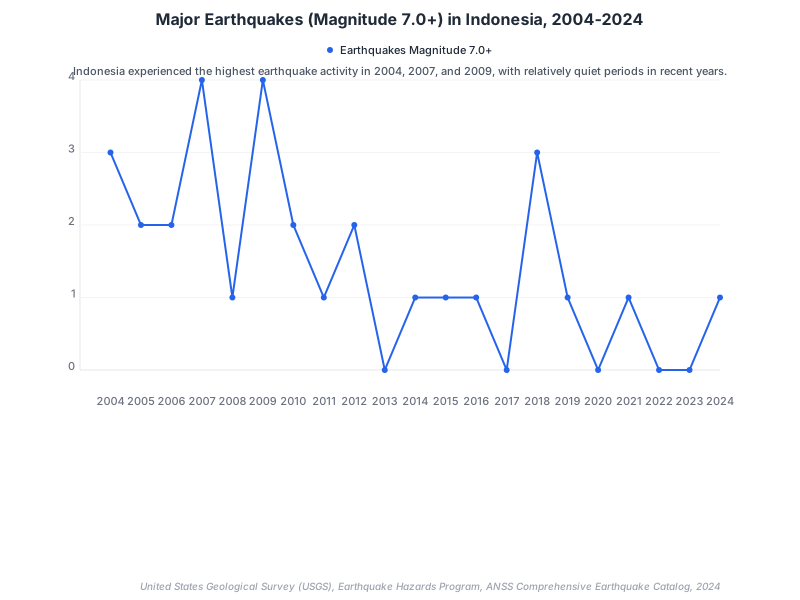
Indonesia has a rich tradition of disaster-inspired music. The 2004 Indian Ocean tsunami, which devastated Aceh province, sparked a renaissance in traditional Acehnese music while also inspiring contemporary Indonesian artists like Iwan Fals and Slank to create benefit songs that raised millions for relief efforts[6]. The gamelan orchestras that performed healing ceremonies demonstrated how traditional musical forms adapt to address contemporary crises.
Economic Drivers: The Business of Disaster Relief Music
The music industry's response to disasters reveals complex economic dynamics that extend beyond charitable impulses. Benefit concerts and charity singles have become major enterprises that reshape industry practices. Live Aid in 1985, organized in response to Ethiopian famine, raised approximately $127 million while establishing the template for large-scale benefit concerts[7]. The event's success demonstrated that disaster relief could generate massive revenue streams while building artist profiles and industry partnerships.
Streaming platforms have created new models for disaster relief music distribution. Following major disasters, platforms like Spotify and Apple Music have developed charitable initiatives, though the specific mechanisms and revenue amounts vary by event and are not always publicly disclosed. This model has been replicated for wildfires, earthquakes, and other disasters, creating funding mechanisms that extend beyond immediate crisis periods.
However, the economics aren't always straightforward. Independent musicians often struggle to participate in major benefit efforts due to industry gatekeeping, while major labels sometimes use disaster relief as marketing opportunities. The contrast between grassroots fundraising efforts by local musicians and corporate-sponsored mega-events reveals tensions between authentic community response and commercial exploitation.
Genre Evolution: How Crises Shape Musical Innovation
Natural disasters don't just inspire individual songs—they catalyze entire genre transformations. The urban decay of 1970s New York created conditions that birthed hip-hop culture in the South Bronx[9]. DJ Kool Herc's block parties emerged from community efforts to address social breakdown, demonstrating how crisis conditions can foster entirely new musical forms.
Electronic music has proven particularly adaptable to disaster themes. Ambient artists like Brian Eno and Tim Hecker have created compositions that sonically represent environmental collapse, while techno producers in Detroit used industrial decay as inspiration for mechanical rhythms that reflected urban devastation[10]. The genre's emphasis on repetitive patterns and synthetic sounds provides unique tools for representing both destruction and regeneration.
Country music's response to natural disasters has evolved from individual tragedy songs to broader narratives about climate change and environmental justice. Artists like Brad Paisley and Keith Urban have moved beyond traditional disaster ballads to address systemic issues, while Americana artists like Ryan Adams and Lucero have created concept albums exploring environmental themes[11].
Technology and Transformation: Digital Age Disaster Response
Social media and streaming technology have fundamentally altered how musicians respond to disasters. The 2010 Haiti earthquake saw unprecedented real-time musical response through platforms like YouTube and Twitter, with artists creating and sharing benefit songs within hours of the disaster[12]. This immediacy enables rapid fundraising and awareness, though it can also lead to superficial responses that prioritize viral content over sustained support.
Artificial intelligence and music production software have democratized disaster response music creation. Bedroom producers can now create professional-quality benefit tracks without major label support, while AI tools enable rapid composition and distribution. However, this technological accessibility raises questions about authenticity and the relationship between technological mediation and genuine emotional expression.
Virtual reality and immersive audio technologies are creating new possibilities for disaster-themed musical experiences. Artists like Laurie Anderson and Arca have experimented with VR installations that combine music with simulated disaster environments, creating empathy-building experiences that traditional recordings cannot achieve[13].
Cultural Healing: Music as Community Response Mechanism
Beyond individual artistic expression, music serves crucial community healing functions following disasters. Ethnomusicologists have documented how traditional healing songs adapt to address contemporary traumas, with indigenous communities worldwide using ancestral musical practices to process modern disasters[14]. These practices often involve call-and-response patterns that rebuild social connections fractured by displacement and loss.
Gospel and spiritual music traditions have proven particularly resilient in disaster contexts. Following Hurricane Katrina, New Orleans churches became centers for musical healing, with artists like the Preservation Hall Jazz Band and Treme Brass Band performing in temporary venues that served as community gathering spaces[15]. The tradition of jazz funerals provided a cultural framework for processing mass casualties while celebrating survival.
Youth music programs have emerged as important disaster recovery tools. Research in music therapy and education suggests that musical activities can help children process trauma while building resilience for future challenges[16]. These programs often combine traditional musical instruction with therapeutic techniques, creating hybrid approaches that address both artistic development and mental health needs.
Political Mobilization: From Mourning to Movement
The most powerful disaster-inspired music transcends immediate relief to catalyze long-term political change. Bob Dylan's "A Hard Rain's A-Gonna Fall," written during the Cuban Missile Crisis, used apocalyptic imagery to critique Cold War politics while inspiring anti-war movements[17]. The song's enduring relevance demonstrates how disaster-themed music can address both immediate crises and systemic issues.
Climate change has become the defining disaster narrative of the 21st century, inspiring a new generation of politically engaged musicians. Artists like Radiohead, Björk, and Grimes have created albums that address environmental collapse while proposing alternative futures[18]. Their work demonstrates how contemporary musicians use disaster themes to build movements for systemic change rather than merely documenting specific events.
Hip-hop artists have been particularly effective at connecting natural disasters to broader social justice issues. Following Hurricane Katrina, artists like Kanye West, Lil Wayne, and Juvenile created tracks that explicitly linked government disaster response failures to systemic racism and economic inequality[19]. This approach has influenced how other genres address disaster themes, moving beyond individual tragedy narratives toward structural analysis.
Future Implications: Preparing for Tomorrow's Disasters
As climate change increases disaster frequency and severity, musicians are developing new approaches to crisis response. Collaborative platforms like Bandcamp have created infrastructure for rapid benefit album releases, while organizations like Music Declares Emergency are building networks for sustained climate activism[20]. These developments suggest that disaster-inspired music is evolving from reactive response toward proactive preparation.
Artificial intelligence and predictive modeling are enabling new forms of musical expression related to environmental change. Contemporary composers and electronic artists are experimenting with data sonification techniques that transform climate and environmental data into musical compositions, creating sonic representations of environmental change patterns. This approach represents a shift from documentation toward prediction and awareness-building.
The global nature of contemporary disasters requires international musical collaboration frameworks that transcend traditional industry boundaries. Initiatives like Playing for Change and the Global Music Diplomacy Initiative are creating structures for rapid cross-cultural musical response to disasters, suggesting that future crisis music will be increasingly collaborative and globally coordinated[22].
While benefit concerts and disaster-inspired music often generate headlines and emotional responses, critics argue they may actually hinder effective relief efforts by creating a false sense of action among participants. The spectacle of celebrity-driven musical responses can redirect public attention and resources away from the unglamorous but essential work of long-term recovery, infrastructure rebuilding, and policy reform that disasters typically expose as necessary.
Some disaster survivors and community advocates contend that the music industry's rapid response to tragedies represents a form of cultural exploitation, where artists and labels capitalize on human suffering for career advancement and profit. This "disaster capitalism" in the music world may inadvertently silence authentic local voices and traditional healing practices, replacing community-driven recovery with externally imposed musical narratives that serve industry interests more than survivor needs.
Key Takeaways
- Natural disasters consistently inspire musical innovation across all genres, from blues and folk to hip-hop and electronic music
- Disaster-inspired music serves multiple functions: individual healing, community building, fundraising, and political mobilization
- The music industry has developed sophisticated economic models around disaster relief, generating hundreds of millions in charitable revenue
- Technology is transforming disaster response music from reactive documentation to proactive preparation and prediction
- Contemporary musicians increasingly connect specific disasters to broader systemic issues like climate change and social inequality
- Traditional healing music practices provide resilient frameworks for processing modern traumas across cultures
- The future of disaster-inspired music will likely emphasize international collaboration and AI-assisted composition
References
- Barry, John M. Rising Tide: The Great Mississippi Flood of 1927 and How It Changed America. Simon & Schuster, 1997.
- Klein, Joe. Woody Guthrie: A Life. Knopf, 1980.
- Spera, Keith. "New Orleans Music Post-Katrina." The Times-Picayune, August 29, 2015.
- Condry, Ian. "Hip-Hop Japan: Rap and the Paths of Cultural Globalization." Duke University Press, 2006.
- Turino, Thomas. Moving Away from Silence: Music of the Peruvian Altiplano and the Experience of Urban Migration. University of Chicago Press, 1993.
- Weintraub, Andrew N. "Dangdut Stories: A Social and Musical History of Indonesia's Most Popular Music." Oxford University Press, 2010.
- Geldof, Bob. "Is That It?" Sidgwick & Jackson, 1986.
- Chang, Jeff. Can't Stop Won't Stop: A History of the Hip-Hop Generation. St. Martin's Press, 2005.
- Sicko, Dan. Techno Rebels: The Renegades of Electronic Funk. Billboard Books, 1999.
- Pecknold, Diane. The Selling Sound: The Rise of the Country Music Industry. Duke University Press, 2007.
- Katz, Mark. Capturing Sound: How Technology Has Changed Music. University of California Press, 2010.
- Anderson, Laurie. "Virtual Reality and the Future of Music." Leonardo Music Journal, 2018.
- Titon, Jeff Todd. Worlds of Music: An Introduction to the Music of the World's Peoples. Schirmer, 2009.
- Sakakeeny, Matt. Roll with It: Brass Bands in the Streets of New Orleans. Duke University Press, 2013.
- Kratus, John. "Music Education at the Tipping Point." Music Educators Journal, 2007.
- Shelton, Robert. No Direction Home: The Life and Music of Bob Dylan. Beech Tree Books, 1986.
- Dibben, Nicola. "Nature and Nation: National Identity and Environmentalism in Popular Music." Popular Music, 2009.
- Miller, Monica R. "Religion and Hip Hop." Routledge, 2012.
- Music Declares Emergency. "Annual Impact Report." Music Declares Emergency, 2023.
- Fosler-Lussier, Danielle. Music in America's Cold War Diplomacy. University of California Press, 2015.