
Why do oil prices control everything when we have so many other energy sources?

The global economy's relationship with oil prices remains one of the most perplexing aspects of modern finance. Despite decades of diversification efforts, renewable energy investments, and alternative energy development, crude oil prices continue to exert outsized influence on everything from stock markets to grocery bills. When oil prices surge, inflation follows, transportation costs spike, and entire economies can shift into recession. When they plummet, energy companies collapse, and oil-dependent nations face fiscal crises. This phenomenon persists even as solar, wind, nuclear, and natural gas have dramatically expanded their share of the global energy mix, raising a fundamental question: why does oil still control so much of our economic destiny?
The Infrastructure Reality: Oil's Embedded Dominance
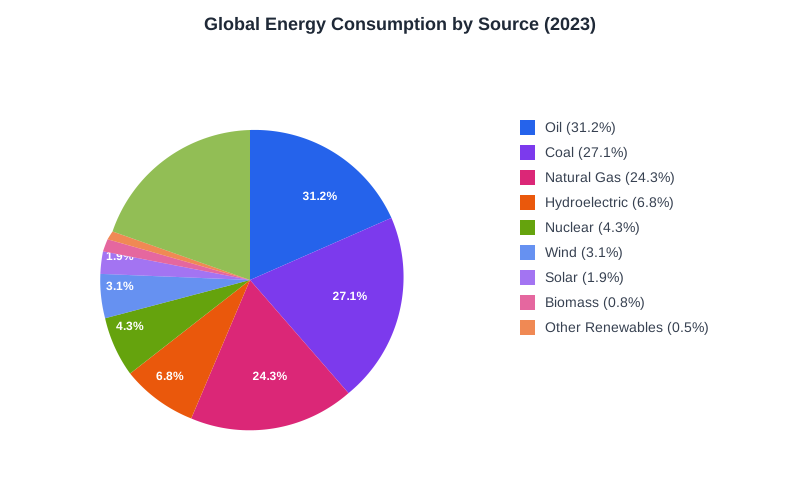
The answer begins with understanding that energy transitions occur over decades, not years, and oil's dominance is literally built into the infrastructure of modern civilization. The International Energy Agency reports that oil still accounts for approximately 31% of global energy consumption as of 2023, making it the largest single energy source worldwide[1]. More critically, oil dominates specific sectors where alternatives remain limited or economically unviable.
Transportation represents oil's most entrenched stronghold. The U.S. Energy Information Administration notes that transportation accounts for roughly 70% of total U.S. petroleum consumption[2]. While electric vehicles are gaining market share, they represented only about 14% of global car sales in 2022[3]. The existing fleet of over 1.3 billion internal combustion engine vehicles worldwide creates what economists call "capital stock inertia"—the tendency for large, long-lived investments to perpetuate existing technologies long after better alternatives emerge[4].
Aviation and maritime shipping present even greater challenges. Commercial aircraft and cargo ships have few viable alternatives to petroleum-based fuels. A Boeing 777-300ER burns approximately 2,300-2,500 gallons of jet fuel per hour during cruise flight, and no battery technology currently exists that could power long-haul flights[5]. Similarly, the massive container ships that carry 90% of global trade rely on heavy fuel oil, with the largest vessels consuming up to 250 tons of fuel daily.
The Petrochemical Foundation of Modern Life
Oil's influence extends far beyond energy through its role as a feedstock for petrochemicals. The American Chemistry Council estimates that petrochemicals derived from oil and natural gas serve as building blocks for over 6,000 everyday products[6]. Plastics, synthetic fabrics, pharmaceuticals, fertilizers, cosmetics, and countless other products depend on petroleum-derived chemicals.
This petrochemical dependency creates price transmission mechanisms that amplify oil's economic impact. When crude prices rise, the cost of producing everything from smartphone cases to agricultural fertilizers increases. Farmers face higher input costs, which translate to higher food prices. Manufacturers see rising materials costs, leading to increased consumer prices across numerous sectors. These ripple effects occur regardless of whether a country has diversified its electricity generation away from oil.
The scale of this dependency is staggering. The global petrochemicals market was valued at approximately $597 billion in 2021, with demand expected to grow by 3-4% annually through 2030[7]. Unlike energy applications where substitutes exist, many petrochemical applications have no viable alternatives at current technology levels and costs.
Financial Markets and the Oil Price Signal
Oil prices function as a critical economic signal that influences financial markets, monetary policy, and investment decisions worldwide. Traders and investors view oil as a leading indicator of economic health, inflation trends, and geopolitical stability. This creates a feedback loop where oil price movements trigger broader market reactions that can become self-reinforcing.
The correlation between oil prices and inflation remains strong despite energy diversification. Research by the Federal Reserve Bank of Dallas indicates that oil price increases have measurable effects on inflation expectations and core inflation measures, though the precise magnitude varies with economic conditions and monetary policy responses[8]. Central banks monitor oil prices closely when setting monetary policy, as energy costs affect both headline inflation and consumer spending patterns.
Oil's role as a global commodity traded in U.S. dollars adds another layer of complexity. The "petrodollar system" means that oil price fluctuations affect currency exchange rates, international trade balances, and global financial system stability. When oil prices rise, oil-importing nations face increased current account deficits, while oil exporters accumulate dollar reserves that they recycle through global financial markets.
Geopolitical Leverage and Supply Concentration
Geographic concentration of oil reserves grants certain nations disproportionate influence over global energy markets. The Organization of Petroleum Exporting Countries (OPEC) controls approximately 40% of global oil production and holds about 79% of proven reserves[9]. This concentration allows coordinated supply decisions that can dramatically impact global prices.
Recent events have demonstrated this power vividly. Russia's invasion of Ukraine in 2022 sent oil prices soaring above $130 per barrel, despite Russia representing only about 12% of global oil production[10]. The market's reaction reflected not just the immediate supply disruption, but also concerns about broader geopolitical instability and potential future supply constraints.
Alternative energy sources, while growing rapidly, lack this concentrated control structure. Solar and wind resources are more geographically distributed, and the raw materials for renewable technologies (while concentrated in some cases) don't create the same level of supply vulnerability as oil. However, this geographic distribution also means that no single policy decision or geopolitical event can quickly increase alternative energy supply to offset oil market disruptions.
The Speed and Scale Challenge
When oil prices spike, the economic impact occurs immediately, but alternative energy sources cannot rapidly scale up to fill the gap. Oil markets are characterized by relatively inelastic short-term supply and demand, meaning that small supply disruptions or demand changes can cause large price movements. The U.S. Strategic Petroleum Reserve, the world's largest emergency oil stockpile, contains only about 90 days' worth of U.S. imports—a buffer measured in months, not years[11].
In contrast, building new renewable energy capacity takes years. A typical offshore wind project requires 5-10 years from initial planning to operation. Nuclear plants can take 10-15 years to construct. Even relatively quick renewable projects like solar farms require 12-24 months for development and construction. This temporal mismatch means that oil price shocks create immediate economic stress that cannot be quickly relieved by ramping up alternative energy production.
The International Renewable Energy Agency projects that renewable energy capacity must triple by 2030 to meet climate goals, requiring annual investments of $4.5 trillion[12]. While this represents unprecedented growth, it also highlights the scale of the challenge in reducing oil dependency within relevant timeframes for economic planning.
Economic Inertia and Transition Costs
The persistence of oil's economic influence also reflects the enormous costs of transitioning away from petroleum-based systems. McKinsey & Company estimates that achieving net-zero emissions globally will require $275 trillion in cumulative spending on physical assets between 2021 and 2050[13]. This represents approximately 7.5% of global GDP annually—a massive reallocation of economic resources.
Individual consumers and businesses face similar transition costs on a smaller scale. Replacing a gasoline vehicle with an electric one requires not just the purchase price difference, but also potential home charging infrastructure, range anxiety considerations, and changes in travel patterns. Commercial trucking companies must weigh the higher upfront costs of electric vehicles against uncertain fuel savings and charging infrastructure availability.
These transition costs create what economists call "switching costs"—the expenses and inconveniences associated with changing from one technology to another. High switching costs slow adoption of alternatives and extend the period during which oil maintains its economic influence.
Market Structure and Price Discovery
Oil markets have developed sophisticated price discovery mechanisms over decades, creating transparent, liquid markets that efficiently incorporate new information. The NYMEX crude oil futures contract is one of the world's most actively traded commodities, with daily trading volumes often exceeding 500,000 contracts representing 500 million barrels of oil[14].
This market depth and liquidity mean that oil prices respond quickly to supply and demand changes, geopolitical events, and economic data. Alternative energy sources lack comparable market structures. There is no "global solar price" or "wind futures market" that provides real-time price signals for renewable energy. Instead, renewable energy prices are typically set through long-term power purchase agreements or regulated utility rates that change slowly.
The absence of dynamic pricing mechanisms for alternative energy sources means they cannot provide the same economic signaling function as oil markets. When oil prices spike, the signal is immediate and global. When solar or wind costs change, the information transmits slowly through the economy via contract renegotiations and regulatory proceedings.
However, oil's continued market dominance might reflect genuine economic efficiency rather than mere institutional inertia. The same infrastructure investments and price volatility that critics cite as weaknesses could actually represent sophisticated market mechanisms that have evolved to handle the complex logistics of moving energy across global supply chains—something renewable alternatives have yet to replicate at scale.
Historical energy transitions offer a different perspective on current progress: the shift from wood to coal took nearly a century, and coal to oil required decades of parallel infrastructure development. By this standard, achieving 14% electric vehicle adoption and 30% renewable electricity generation within just two decades might represent unprecedented speed rather than disappointing sluggishness in energy system transformation.
Key Takeaways
- Oil still represents 31% of global energy consumption and dominates transportation, which accounts for 70% of petroleum use in the U.S.
- Petrochemicals derived from oil are essential components in over 6,000 everyday products, creating price transmission effects throughout the economy
- Oil functions as a critical economic signal in financial markets, with strong correlations to inflation and monetary policy decisions
- Geographic concentration of oil reserves in OPEC countries (79% of proven reserves) provides coordinated supply control that alternative energy sources lack
- The temporal mismatch between immediate oil price impacts and the years required to build alternative energy capacity perpetuates oil's influence
- Massive transition costs ($275 trillion globally through 2050) and switching costs for consumers and businesses slow the adoption of alternatives
- Sophisticated oil market structures provide real-time price discovery that alternative energy markets cannot yet match
References
- International Energy Agency. "Oil 2023." IEA, June 2023.
- U.S. Energy Information Administration. "Use of Oil." EIA, 2023.
- International Energy Agency. "Global EV Outlook 2023." IEA, April 2023.
- International Organization of Motor Vehicle Manufacturers. "Vehicles in Use." OICA, 2023.
- Boeing Company. "777 Technical Specifications." Boeing Commercial Airplanes, 2023.
- American Chemistry Council. "The Business of Chemistry." ACC, 2023.
- American Chemistry Council. "Chemical Industry Facts." ACC, 2022.
- Federal Reserve Bank of Dallas. "Oil Prices and Inflation Expectations." Economic Letter, April 2022.
- Organization of Petroleum Exporting Countries. "OPEC Share of World Crude Oil Reserves." OPEC, 2023.
- U.S. Energy Information Administration. "Russia Country Analysis." EIA, 2023.
- U.S. Department of Energy. "Strategic Petroleum Reserve." DOE, 2023.
- International Renewable Energy Agency. "World Energy Transitions Outlook 2023." IRENA, March 2023.
- McKinsey & Company. "The Economic Transformation: What Would Change in the Net-Zero Transition." McKinsey Global Institute, 2022.
- CME Group. "Crude Oil Futures." NYMEX, 2023.